


You’re a good mid-level leader, full-stop. But here’s a dicey hunch: your immigrant employees still feel uneasy about you.
This hunch arises from a podcast conversation with Dr. Lola Adeyemo, as well as the Mode/Switchers: Ken the Boomer, Emily the Xennial, LaShone the Millennial and Madeleine the Gen Z. Check it out by hitting the play button above.
This Pod Provoked a Mindset Shift for Me
Over the past few years, I’ve hired a number of international practitioners for positions on the Mode/Switch Team. They helped me run socials, edit podcasts, and produce video stories.
But for all our interactions, I rarely felt like I knew these talented people.
Sometimes, embarrassingly, I couldn’t even pronounce their given names. I relied instead on their Americanized nicknames.
My way of coping with the gaps between us was to rely on Social Penetration Theory. The gist of Altman & Taylor’s theory is that people are like onions. If I peel back layers of my self, maybe you’ll do the same. Eventually, we’ll know each other’s true selves.
Unfortunately, my attempt at, um, workplace onionizing has never fully worked.
This week’s podcast with Dr. Lola Adeyemo showed me the problems with my onion. Her discussion of the complexities immigrant employees carry into the workplace provoked a different metaphor:
My employees and I are more like garlic cloves than onions. That suggestion comes from Internal Family Systems theorist Richard Schwartz, who says people are collections of cloves, clustered around their true selves (No Bad Parts 27).
That’s the mode/switch I’ve been needing:
Stop treating workers like onions. Start connecting to their unseen cloves.

Cloving Your Communication Practices
Most of theories about communicating with someone different from yourself involve respectful and reciprocal self-disclosure. If you candidly share a layer of yourself, the other person will disclose a layer as well. So long as the costs of self-disclosure are manageable, you’ll each gradually reveal yourselves. That’s the hope anyway. And sometimes it actually happens. But not always. Maybe not even often.
After this podcast, I want to try cloving my managerial communication, learning to adapt to clusters of meaning I can’t see right way. That might entail the following:
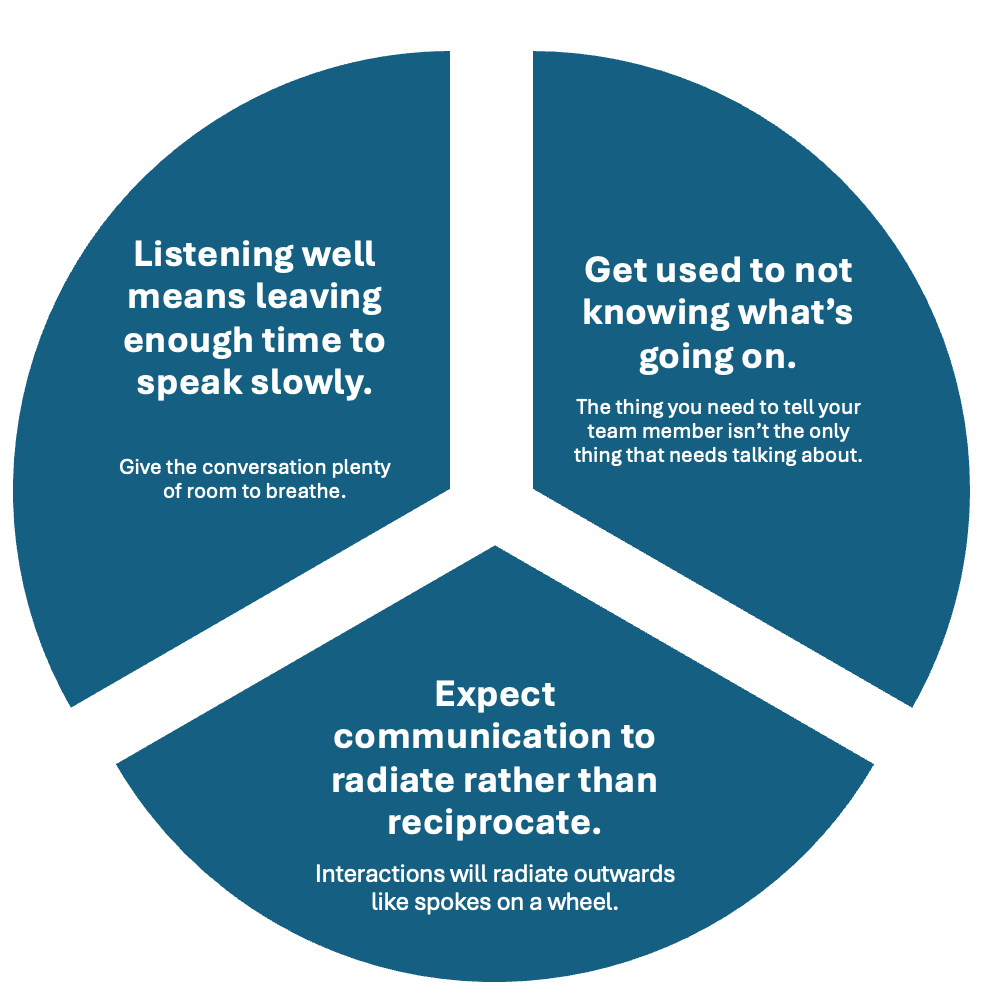
Get used to not knowing all that’s going on. The thing you need urgently to tell your team member feels so clear to you. And it is! But it probably isn’t the only thing that needs talking about. There are lots of nearby issues, clustered in all sorts of hidden cloves.
Expect interaction to radiate rather than reciprocate. You’re used to back-n-forth-ness: I speak, then you speak. I listen, and then you listen. But when you are alert to people’s cloves, your conversation will radiate outwards like wheel spokes. This will connect with that, connecting that to those and those to them.
Listening well means leaving enough time to speak. Dr. Lola says we often misinterpret employee silence as agreement. But quietness might also mean that your immigrant employee has so much to say that they need to say it slowly and repeatedly. Give the conversation plenty of room to breathe.
Mid-Level Leadership Means Being an Interpreter
Dr. Lola emphasizes that your immigrant employees are never just one thing. They are much, much more than work-related communications might initially suggest.
The same thing’s true for all the people in your organization, of course. We all have cloves of family life, neighborhood life, community sports, churchly engagements, whatever. Each touches on the others, though not all of them are quickly visible.
But when it comes to your immigrant employees, the cloves aren’t just hard to see; they may be, at least at first, incomprehensible. They may require translation.
Fortunately, you have some very human language in common with your immigrant employees: narrative. Humans are storytelling animals, as Alisdair MacIntyr puts it. So translating your workers’ experiences requires listening for what Dr. Lola calls the untold stories.
I hope you’ll give this conversation a half hour of your day. It’ll reward consideration. But if now’s not the right time, would you quickly click this link to the pod on Spotify or to this link on Apple Podcasts? Then give it a listen on your ride home.


You can connect with Lola Adeyemo on LinkedIn or on her website, which notes that she “is a TEDx keynote speaker, author, and workplace inclusion strategist who helps leaders and organizations navigate intersectionality, activate ERGs, and build cultures where people and performance thrive. Her work blends research, lived experience, and practical strategy—making belonging not just something people feel, but something leaders know how to lead.”


