

Your communication with a team doesn’t just convey instructions. It does stuff.
That’s an insight from communication theory. But it’s also a persistent insight from this week’s podcast conversation with Better Life Lab’s Brigid Schulte, author of the recent book Over Work, a journalistic investigation of job addiction and its causes. For her, managerial communication can generate a lot of what she calls “stupid work.”
Talking with Brigid on the pod made me rethink this story about Courtney Kalous from my own research on workplace digital overwhelm:
Courtney Kalous told me her family motto: “Kalouses Don’t Quit.” When she took a job at a nonprofit after college, she took that slogan with her. She told me, “I have this personality that’s like, Oh my gosh, I have to knock it out of the park. I have to answer the email the fastest. I have to really prove myself.” That slogan provoked her to pursue a relentless schedule, something like this:
5:30 AM: Crawling to the end of her bed to her laptop buried in throws. Email!
6:00 AM Hit the shower.
8:00 AM Off to work at a dead run.
9:00 AM - 5:00 PM Taking notes, writing policies, and putting her bosses’ proliferation of ideas into action.
6:00 PM She’d connect with a volunteer for dinner.
8:00 PM More laptop projects till a late bedtime.
When I first heard this story, I obsessed on the warping power of the family slogan. Kalouses Don’t Quit. Courtney had internalized those words as an unsustainable work ethic. But Brigid’s conversation with this week’s Mode/Switch Team (Madeline, LaShone, & me) showed me how Courtney’s leaders contributed to Stupid Work, too.
Stupid Work: Work that looks impressive and generative but which is actually marginal to your organization’s mission.
When your team does Stupid Work, you can be sure there are two factors at play. Like Courtney, they will have internalized various work ethics. But they will also feel the external pressure of your organization’s culture and (quite possibly) your managerial communication.
Courtney’s bosses generated an endless number of new ideas. They were (she noted) “visionaries.” But most of these ideas never went into operations. They couldn’t. There wasn’t infrastructure to implement them. But there was a Courtney. And an exhausting part of her work was discerning which of the cajillion ideas the company could do and which of those ideas just had to die.
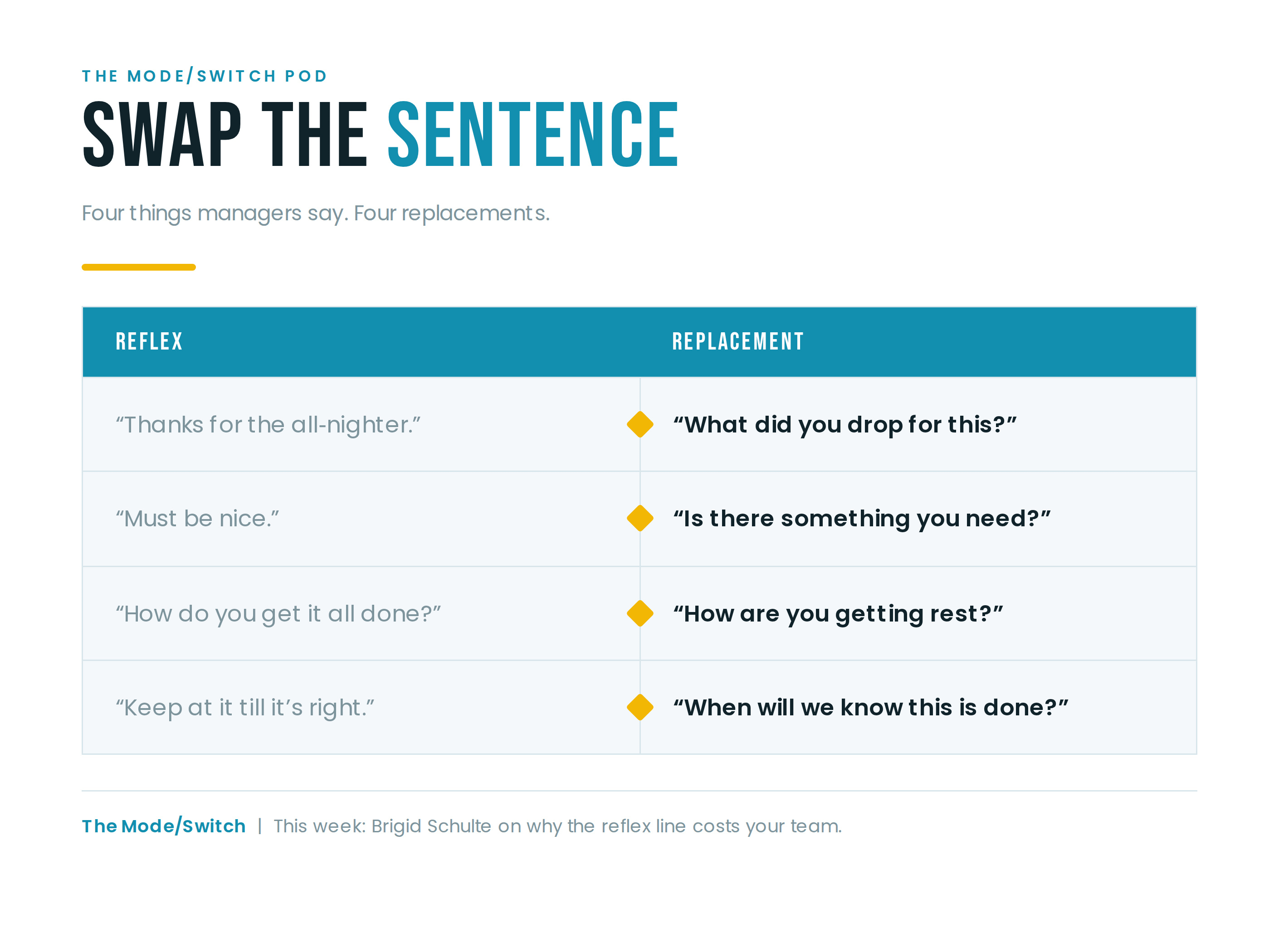
I’m sure Courtney’s managers were pleasant people. I’m sure they said, “Thanks for what you do!” and “Appreciate you!” and “Wow, you’re up at 5:30 sending emails!” But the weird thing about compliments like those is, they mean well but do harm.

Managerial communication like that generates an enormous amount of what Brigid calls Stupid Work, intensive labor that’s marginal to the core work of an organization.
Have you noticed how workplace communication creates Stupid Work at your job?
• When an HR person says, “Wow, this is a team that always gets things done!”
• When someone says, “Dude, you never sleep, do you?” And it’s a compliment.
• When a supervisor evaluates a burned-out worker High on “workplace responsiveness.”
• When a manager jokes, “Nobody takes PTO around here. We wouldn’t know what to do with ourselves!”
Do you see what these have in common? They’re inducements and coercions.
In this week’s podcast, you’ll hear some frank confessions of work addiction from our team. But Brigid’s journalism will help you do more than treat your overwork. She will also help you tell an entirely new story about work itself.
So, what happened to Courtney? I’m happy to say that she found her vocational footing. When COVID hit, she discovered the unexpected gift of not working all the time. And when, later, someone asked her to do Stupid Work, Courtney responded with an evenly voiced no. Her coworker was surprised. What happened to the Courtney who was always willing to do more?
Courtney said simply, “She’s dead.” But I think Brigid would say that what had come alive instead was a Courtney who made room for meaningful work and love and play.
I’m pleased to share this week’s podcast, because I think it could make a difference for you and your team. Here’s one good way to get ready: jot down one thing your higher-ups say to you that tempts you into Stupid Work. Hit reply or comment below!

Podcast Table of Contents
0:00 — Craig comes in tender: why this week’s problem isn’t “out there.” Plus the number behind the episode — a 2026 workforce report finds nearly half of workers now describe themselves as workaholics.
2:30 — The system we’re recording inside: automation reshaping scheduling, algorithmic performance tracking, and middle managers left to translate all of it into actual human conversations.
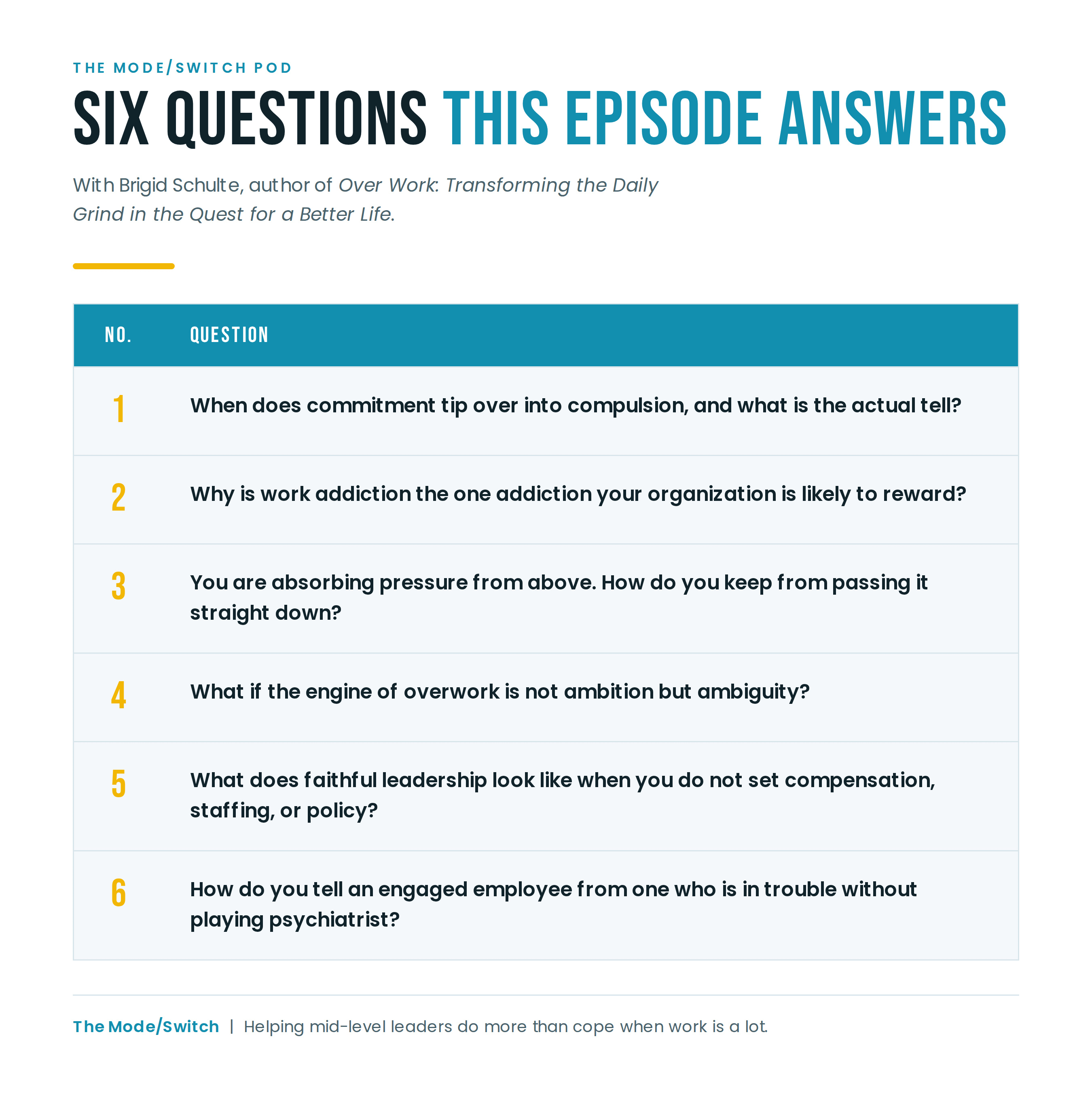
3:20 — Brigid Schulte enters the studio. Where does the line get crossed between commitment and compulsion? On the “ideal worker” cultures that reward presence, busyness, and the appearance of productivity.
6:15 — “It is the only addiction that is rewarded.” Brigid on attending Workaholics Anonymous meetings — and why members close every share by wishing each other strength and hope.
7:10 — Is this an American problem? Internal drivers (fear, insecurity, I’m not enough) collide with external pressure and Elon Musk–style role models. Brigid calls it a double whammy.
8:45 — LaShone asks the middle-manager question: you’re absorbing pressure from above and handing it down. How do you interrupt that? Brigid names “productivity porn” and the corporate monoculture it quietly builds — one that filters out anyone with care responsibilities.
11:45 — Craig on the scripts that circulate at work (“Thanks for working through the night!” / “Must be nice, leaving early”). Brigid goes to Japan for karoshi and to Iceland for shorter hours, and finds the same root in both places: ambiguity about what the work actually is.
15:50 — Generations and boundaries after COVID. Where the “young workers want flexibility, older workers don’t” story holds up — and where the data says it doesn’t.
19:50 — Faithful leadership when you don’t control compensation, staffing, or policy. Your sphere of influence, why rested people do better work, and the six-week arc where the overworkers lose their early lead. Plus a term for what happens next: the productivity cliff.
23:00 — A better story about work — “beyond lunchtime yoga.” Brigid on the change agents who gave her hope, including a family reforming the culture of medicine after losing an ER doctor to burnout.
25:10 — Mode/Switch! Stop stupid work. Brigid’s three concentric circles: the real work, the work around the work, and the performance of work. Why we spend our days in the outer two.
27:35 — Roundtable: Can a mid-level leader misdiagnose work addiction in someone else? Are there workaholic seasons? LaShone on self-awareness and naps, Madeline on “I’ll just make a little progress here,” Craig on why “stupid work” is too close to laugh at. The better questions we might ask each other instead of “How’s work?”
Healing Your Work on Social Media
I invite you to visit a new Substack Jill Risner and I have launched for marketing and communication professionals who hate and need social media. Digital marketers, content creators, strategic communicators—heck, anybody who feels all the cog diss that socials tend to create: this faith-forward publication called Making Peace with Social Media is for you. Subscribe here.


