The Delegator’s Dilemma
Your growing company needs you to delegate your client-facing work. Your client wants you on every call. Here’s how People Smarts and Pattern Smarts help you decide what to do.

When I was 17, I taught myself to ride a unicycle. It took me quite a while to go in any direction, much less the direction I was intending. I would prop myself on the banana seat, put a foot against the bumper of my dad’s car, and then pump the other pedal, launching my calamitous self into the parking lot. It usually took me 3 to 5 seconds to fall. When the wheel shot out from under me, I usually landed on my feet. But the seat got banged up a lot.
I think that’s what mid-level leadership feels like most days. Pumping one pedal, then another, swiveling this way and lurching that, throwing up an arm, tucking the other, seeking momentum within constant instability.
Welcome to the Mode/Switch, a newsletter that helps mid-level leaders and their teams do more than cope when work’s a lot. This week, I’d like to talk about what you might call the left and right pedals of the managerial unicycle: People Smarts and Pattern Smarts.

The other day, I had lunch with a mid-level leader, Jaron, let’s call him, who was clearly good at dealing with unstable conditions. While we talked, he kept screwing and then unscrewing the lid of a Mott’s applesauce pouch for his baby girl in a highchair next to him—all the while, telling me about a workplace impasse.
His company’s growing, which is good news. But that growth shifts him away from what he’s truly good at, which is client-facing work. Now, he’s learning to mentor his team in new tasks that he himself used to do. He doesn’t feel well trained to do this mentoring, though I suspect he’s actually pretty good at it.
But the impasse he’s baffled by is that (a) he needs to delegate more tasks to his team, but (b) the client doesn’t trust the team. They trust Jaron. So, they say things like,
“Hey, can you be on the call this afternoon?”
“No, but my team will be!”
“We’d really like you to be on the call.”
“. . . ”
So that’s the dilemma. Jaron needs his team to do more. His client wants him to do more. It’s an impasse between scaling the company and building client trust. It’s been called the Delegator’s Dilemma (read more here):
If I don’t delegate, I’ll burn out. If I delegate, the client’s gonna go elsewhere.
Jaron’s short-term solution is Do It All. He mentors his team and he shows up on the calls. But it’s like trying to ride a unicycle without pedaling.
People intelligence gets you halfway there
Clearly, if you’re a manager stuck in the Delegator’s Dilemma, you need to know and care for your team’s mentoring needs and you need to know how to talk attentively with your client.
You can build these People Smarts with what Yale researcher Marc Brackett calls a Mood Meter. The instrument asks two questions:
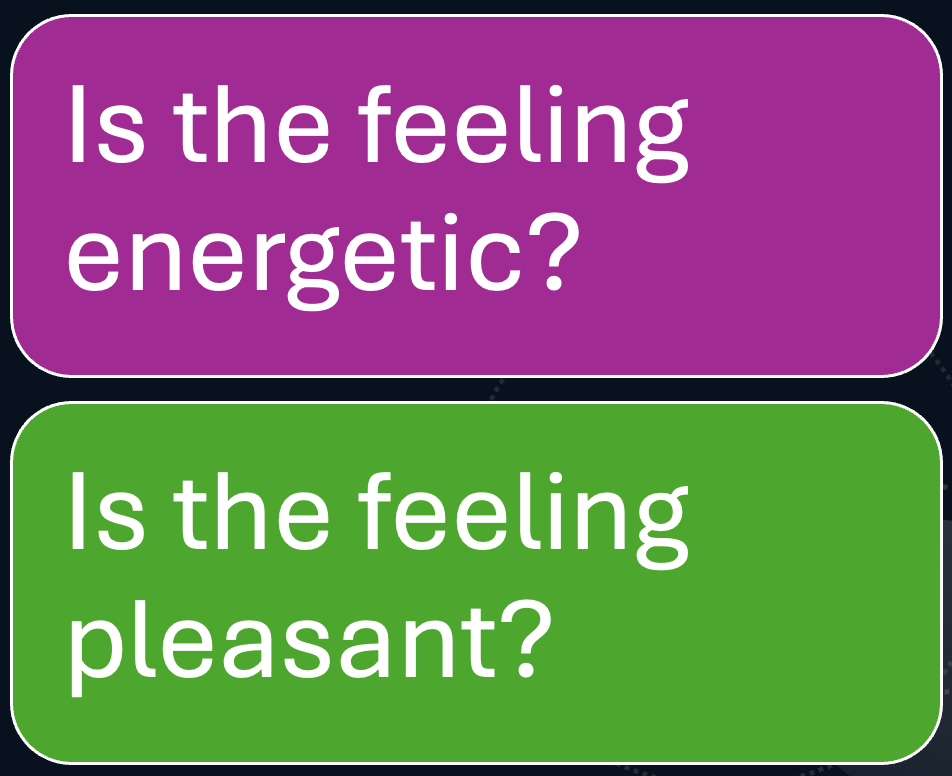
Brackett says people’s feelings are always a blend of both. You can map these feelings (in yourself, your team members, and your client) at the intersection of energy and pleasantness.
Some days, your feelings give high energy, but low pleasantness. Aha, you might say, I feel angry that the client is making way too many demands.
Other days, you have low energy and low pleasantness. Okay, you think to yourself, maybe I’m sad that my team isn’t growing as I’d hoped they would.
Some days, your team exhibits low energy and high pleasantness. They feel content about the situation: they like the predictability of their tasks.
Other days, your client feels high energy and high pleasantness. They love what you’re doing for their last software roll-out. They think you’re great.
Taking your Mode Meter to work will help you to be smarter about how you equip your team with new tasks and how you offer reassurance to your nervous client.
But resolving the Delegation Dilemma requires more than People Smarts. The challenge Jaron faces is more than personal, in other words. The mid-level leader has to figure out what people are feeling, for sure. But he also needs to coordinate the processes and patterns that help create people’s states of mind.
And for that, you don’t just need a Mood Meter. You also need a Mode Meter.
Pattern intelligence gets you the rest of the way
What I’m calling Pattern Smarts, as opposed to People Smarts, draws on a body of theory known as Relational Leadership Theory, which redirects focus from people to processes and then back to people. Think of it this way: People Smarts focus on the state of mind of the person in front of you. But Pattern Smarts focus on the systems all around the person in front of you.
Think about all the background interactions shaping Jaron’s relationships with his team and his client. I tried to sketch these patterns:
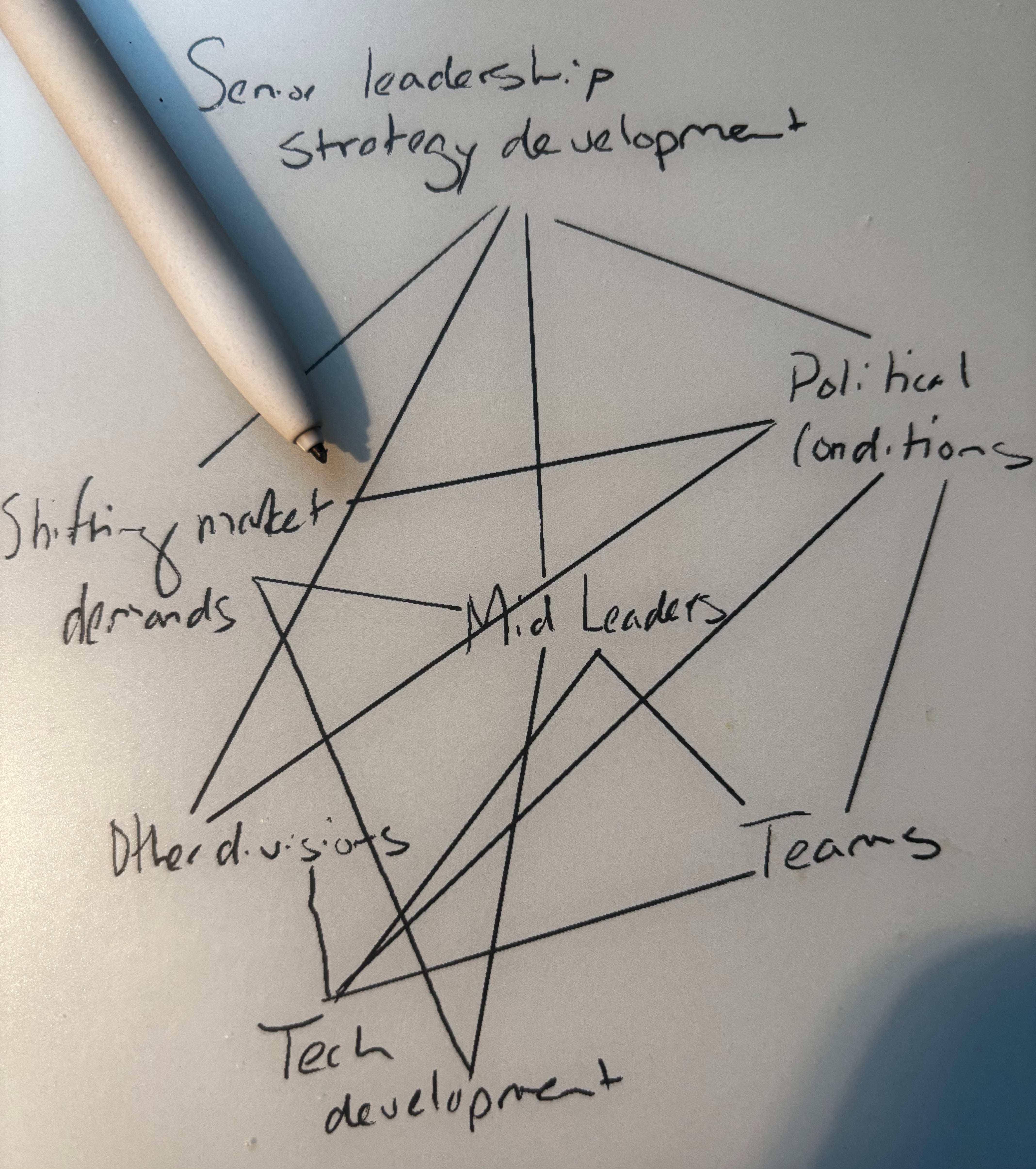
It’s giving Mad Scientist vibes, I know. But a company culture involves a constantly shifting, highly complex pattern of interactions, sometimes visible, sometimes not. And it’s almost impossible to comprehensively map, much less to master and control.
Like a unicyclist, the mid-level leader needs to push forward sometimes with People Smarts, caring for the person in the moment. But then, a second later, the same manager needs to swivel. Pulling back from a needy client or an overwhelmed team member is hard in the moment. You really want to offer care and support and reassurance. Those are, after all, the People Smarts that make your job feel human. But the manager also needs the Pattern Smarts to coordinate with networks of interactions happening all around. It’s dizzyingly hard, and you’ll probably keep sending your unicycle skittering.
What you need is a Mode Meter
My organizational research among millennial managers and Gen Z team members has turned up four simple modes that everybody uses when they communicate at work: sending-out, signaling-at, speaking-with, showing-how.
These modes (unlike the map of systemic interactions I sketched above) are quickly graspable. You know how to do them intuitively. For example, you know how…
to send out a message by email or text or DM
to wordlessly signal that something might be right or wrong
to speak with a client or a teammate, offering honest conversation
to show how to do things
Sending, Signaling, Showing, and Speaking. They’re more than ways to send a message. They are postures that help you link a given conversation with a larger set of background patterns.
Let’s say you sense that a productive pattern in your company is about to be disrupted by an impatient client. In Jaron’s case, for example, his company’s entering a season of growth, which requires a pattern change: they have to redistribute more tasks from mid-level leaders to employees. But the anxious client demands that Jaron show up on each call. For the client, the larger pattern is invisible. So Jaron faces not just an interpersonal challenge, but also a systemic one. He needs to stabilize the company’s essential changes, not just for himself or his team but for the client as well. After all, the client will actually benefit from working with a savvy team.
Should Jaron send, speak, signal, or show? The mode he settles on makes all the difference not just for individual people’s emotional states, but for the ongoing success of an emergent and vital pattern of interactions in the larger company.
Let’s break this down for you into two simple questions.
First, you want to ask a People Smarts question: What does this relationship, right here, right now, need from me?
But then, you want to ask a Pattern Smarts question: What does the larger system, the larger pattern, need from us right here, right now?
Using the Mode Meter helps you choose the most responsible mode for coordinating people and patterns in your organization. You’re not just trying to adapt to the emotional states of people near you; you’re trying to alter their attention so they can see the infrastructural, technological, and policy patterns that affect your interactions.
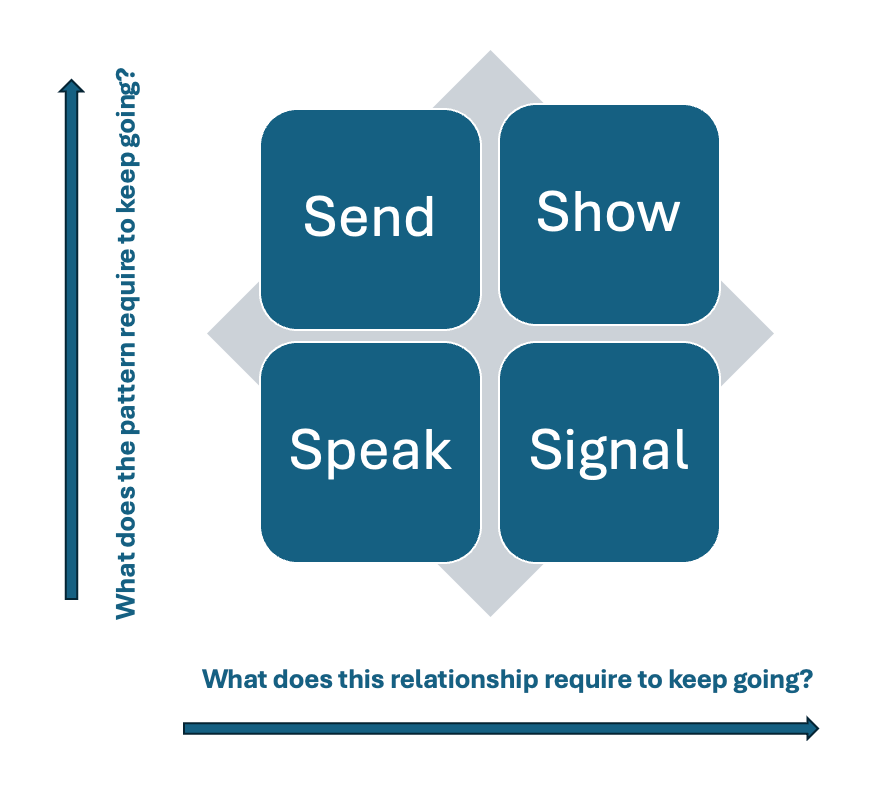
Let’s try out the Mode Meter
For Jaron, the meter proposes asking two questions:
What does the larger pattern require to keep going? The systems of the company require him to share his work with his team. His people need to step up and develop at the speed of a growing company. And the client needs the expertise that comes not just from Jaron’s expertise but from the collective wisdom of a shrewd and savvy team. That’s a good (if fragile) pattern, worth coordinating with.
What does this relationship with a nervous client require? My reflex is to say, reassurance. But I don’t trust my reaction on that one, because using modes of communication isn’t just about conveying messages like, “It’s all good” or “You’ll be fine.” Mode-switching is about helping people to coordinate with invisible patterns. Which mode would do the best job at helping the client to see the larger pattern here of the company’s rapid growth, the manager’s need to delegate, the team’s expanding capabilities?
In my judgment, the urgency of stabilizing the company’s patterns of change is very high, given the growth of the company. If Jaron doesn’t resolve the Delegator’s Dilemma, the company’s profits might suffer—and Jaron himself might burn out. That puts him in the top two squares of the matrix: Sending or Showing. Jaron might send a very long email to explain everything about the changes in task assignment to the client. But, given the nervousness of the client, the relationship needs are pretty intense. So I would go with the upper right quadrant of the Mode Meter and use a mode of Showing.
Here’s what I think the Mode Meter suggests: Schedule a meeting with your client and your team (in-person, if possible). Rehearse and prepare thoroughly with your team, so they are ready to shine in the meeting. When you gather with the client, be lightly in charge, barely guiding the agenda. Say as little as possible. Every time the client asks a question of you, receive it, jot a note, nod your head, and look to your team. Defer to their judgment. Your goal is to use a mode of demonstration, to show the client how good your team actually is.
A final word
At first, I thought the hard part about riding a unicycle was not having handlebars. But I’d been riding bikes no-handed for years.
The real trick was the constant decision-making in unstable conditions. No unicycle manual could tell me when to pedal my right foot and when to flail out my left arm.
For mid-level leaders, pumping one pedal, then another, twisting your team’s wheel one way or the other, takes a lot of practice and tacit knowing. But what guides the constantly precarious process is the goal to coordinate people and patterns across your organization. So you pump, you pedal, you flail, you try first this, then that, and most of all you keep getting back on the banana seat.