


My first return-to-office mandate came from a manager who was also my wife.
A few years ago, I left Chicago for a new professorial job in Grand Rapids. While my wife and I lived apart for a few months, I learned what long-distance couples have long known: texting and calling can leave you sad and lonely. (Our shared Spotify playlist was “Remotely Married.”) Yet when she finally moved to GR a few months later, she told me I should make more use of my on-campus office. “Go be there,” she said with a smile.
Her mandate stung a little. I had gotten used to working from home while she was gone. I had expected to enjoy some of those same arrangements with her.
A friend’s text, however, helped me see the unexpected challenges of sharing an at-home workspace with her spouse. “We handle it pretty well,” she said, “but we actually both talk about missing office life, and coming home and telling each other about our day.”
It’s a relational paradox: nearness can isolate and distance connect.
Understanding this paradox can help managers enforcing return-to-office mandates to capitalize on the “proximity effect” of in-person work.1
Just getting people back in the office won’t automatically improve collaborative productivity or rebuild organizational trust. But paying attention to what brain researchers call “neural synchrony” suggests that in-person work can support effective mentoring and a more reliable team.2
But it all comes down to why you want those brains syncing up.
The Proximity Effect at Work
I encountered a failure of neural synchrony while researching for my book Digital Overwhelm. One rising professional told me that after taking a remote job with a firm, she would laugh at a joke in an email but then see her coworkers’ faces on Zoom and think, Oh, they weren’t joking at all. Her experience showed how hard it can be to connect with coworkers while staring into the depths of a laptop screen. (It didn’t help that her boss never read more than two lines of her emails.)
Sure, it’s possible to exaggerate the power of neural synchrony.3 But Emma Harrington and Natalia Emanuel join this week’s Mode/Switch Pod to argue that what happens when people work in the same location can catalyze stronger working communities.. Their just-released book, In Person: How Working Together Fuels Creativity, Productivity, and Growth, shows how.
“We Liked Remote Work. Then We Looked at the Data.”
I reached out to Emma and Natalia this summer after seeing their New York Times article, which shared data from research on togetherness and work. Their research suggests that a huge benefit of proximity comes with mentoring. Their conversation on this podcast shows how mentoring does more than help rising professionals survive workplace bureaucracy; it also helps them become generous contributors to working community.
If you as a manager are questioning the sacrifices you’re making to show up at work, this podcast’s for you. This week’s conversation fully acknowledges the obnoxiousness of your commute, the expense of childcare, and the peculiar obligation to put on grown-up pants. (Emma’s confession of “marital disharmony” and her husband’s sometimes ambivalence about his commute may be worth the pod.) But the podcast also helps you recognize that the best motivation for RTO may be to support the wisdom and wellbeing of your team.
Regular listeners know that The Mode/Switch Pod features an intergenerational roundtable. I doubt there’s a topic that more requires intergenerational insight than the RTO vs. In-Person debates. I’m glad to be joined by my cohosts Ken the Boomer, David the Xer, Emily the Xennial, and Madeline the Z.
You’ve listened to a lot of management podcasts. But can you ace the following quiz?
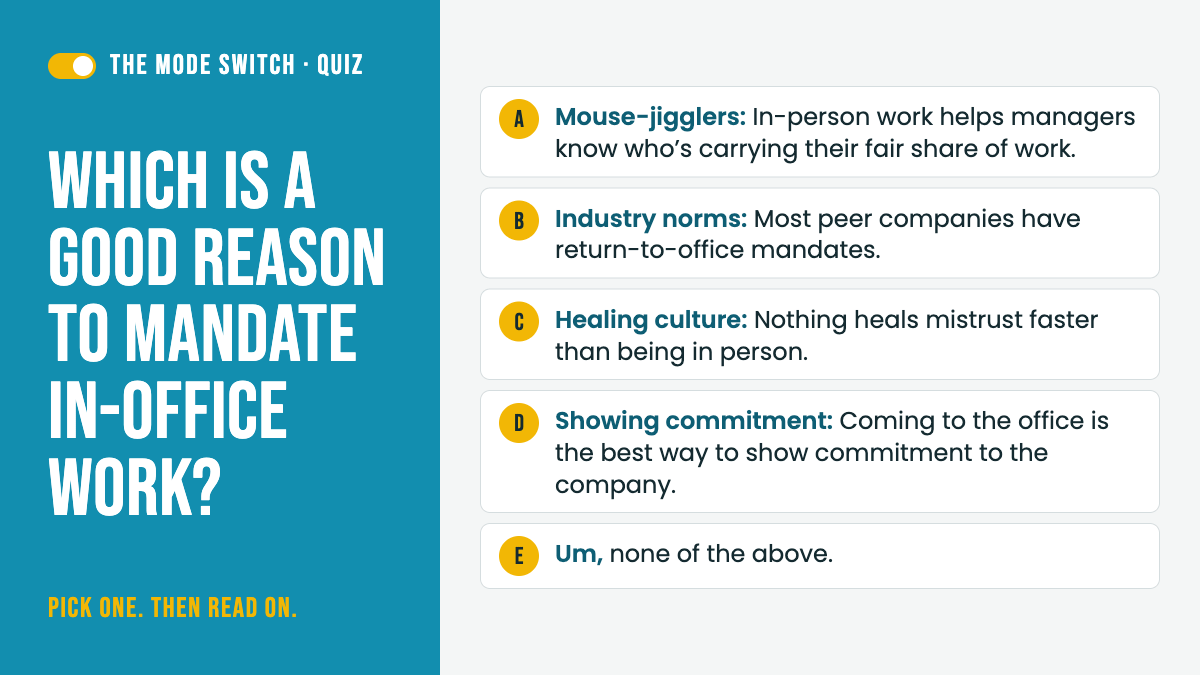
If any of those rationales sounded even subtly persuasive to you as supports for RTO mandates, you should consider pulling a chair up to the Mode/Switch roundtable for our conversation with Emma and Natalia.

The Mode/Switch Pod’s Got a Spin-off!
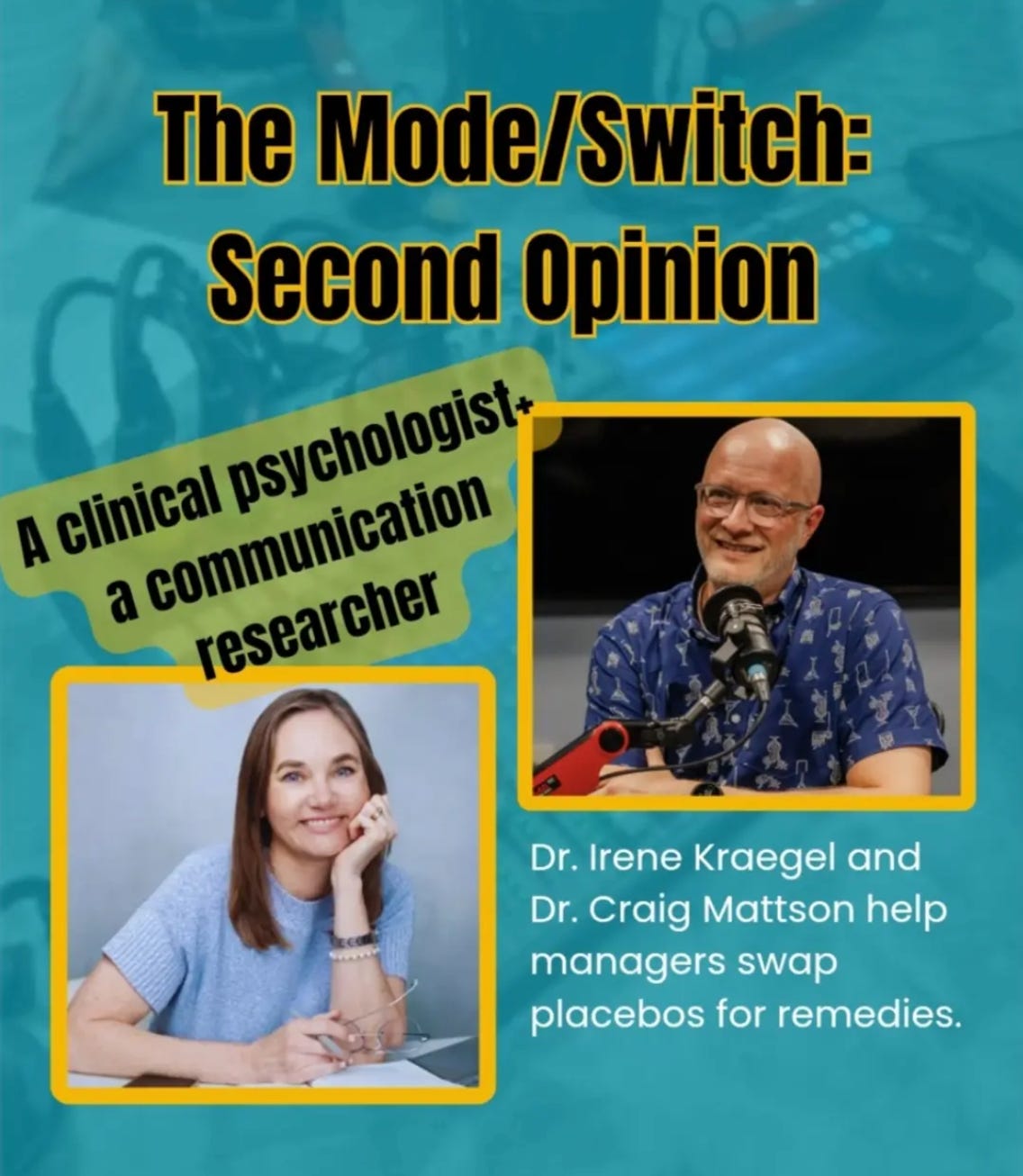
For our first episode of Second Opinion, Irene and I sat down with Dr. Shaq Anthony, who serves as Lead Org Development Specialist at Corewell Health in Grand Rapids. And here’s the problem we worked on with Shaq: how can a mid-level manager communicate a policy to their team when she herself disagrees with it?
Guess what our case study was: return-to-office mandates.
As this week’s guests Emma Harrington and Natalia Emanuel report, software engineers who sat near their teammates got about 18% more feedback on their code.
As electrode experiments have shown, two people talking together can sync up their brains. Or as neuroscientists might put it more carefully: these experiments measure mirrored brain activity.
In the “roundtable” portion of our podcast, we discuss the ancient longing to achieve spiritual connection through friction-free communication. John Durham Peters is the muse for that point. See his indispensable book Speaking into the Air.


