
Sensing the twinges on your team
It's awkward to pay attention to your team's posture, breath, voice, touch. But cultivating that attention tells you things even before anyone's found the words for them.

A slightly alarming procedure
The other day, my physical therapist friend dry-needled me. She had me lie down on a couch and stretch out my left arm. She asked me where the pain was.
I couldn’t even point to the twinge. But I could say that I felt it when I picked up my water bottle and poured out day-old water.
That gave her an idea where the pained muscle was buried deep, twisted and folded with other sinews. Physical therapists see bodies weirdly. They see depths, even in an unremarkable-looking forearm like mine.
Pulling out a needle, she gave me a poke so slight I couldn’t feel it break my skin. But a moment later, it reached the muscle. My legs shot up, and I sang out, “There it is!”
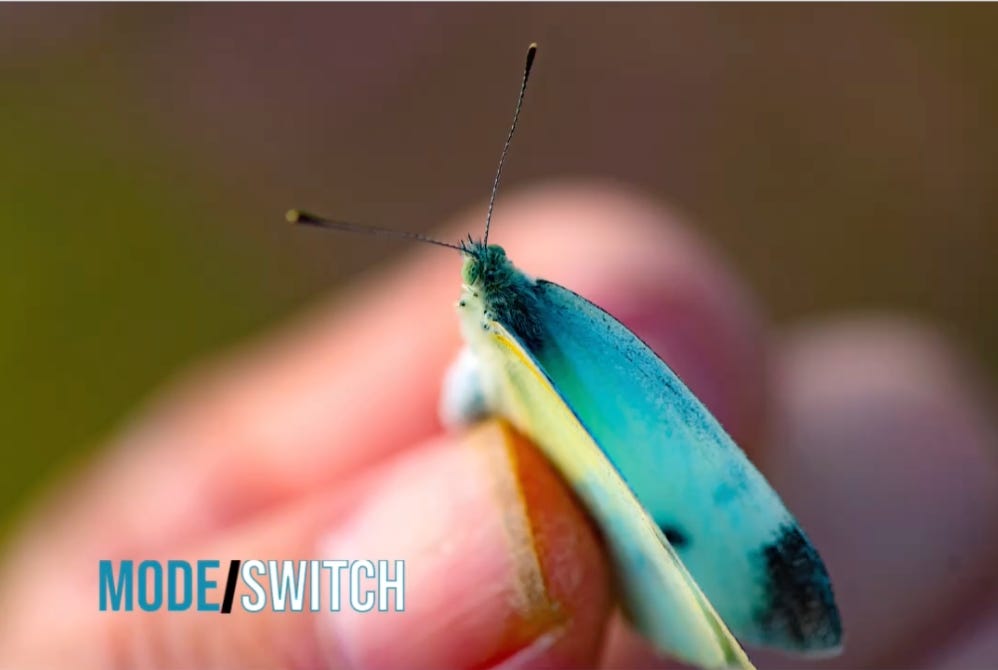
Even apart from my theatrics, though, she knew she’d found my hurting muscle. Her needle was quivering like the antennae of a terrified moth.
I tell this story, not just because dry-needling is a cool procedure. I mean, it actually is cool. Dry-needling lets in blood and oxygen to a neglected muscle, achieving in two minutes what would otherwise take a quarter hour of painful pressure even to begin.
But I tell this story to raise attention to the trouble often buried in the muscles and postures and stances and voices of your team.
Why pay attention to the embodiment of your team?
Because not noticing these things means missing what’s twitching below the surface. And stuff will come out—eventually.
In crying. In staring. In sleepiness. In silence. In yelling.
A couple of stories
Story #1: A friend of mine, Richard, let’s call him, told me his senior leadership’s been shouting a lot lately. The CEO starts shouting in the office. People flinch. He says, “I’m not angry, I’m passionate.” But it freaks people out. An assistant pushes in her earbuds, trying to keep her fingers on her keyboard. Others leave the room by the nearest door.
But Richard, who’s a mid-level leader, has figured out what’s going on. “He wants us to shout back. He calls it ‘giving feedback.’”
When there’s shouting in the office, you can bet the yeller is feeling helpless. Instead of noticing what’s twinging deep in him, he tries to normalize all the shouting.
Story #2: Three people are standing, chatting: Kaylee, Dirk, Chakena. A fourth person comes up behind Kaylee, startling her. She goes rigid, eyes bugged. Her breath has stopped.
Dirk responds uneasily. He turns sideways, avoiding Kaylee’s stress response. He tries to keep the conversation going. But Chakena recognizes Kaylee’s symptoms as PTSD.
She asks her, “Do you need a hand to hold?” Kaylee shakes her head and then adds, “No, but could you put your hand on my shoulder?”
Chakena does that for a moment. Kaylee’s breathing returns to normal.
A mode/switch to recommend
The first story above points to the deep affective realities of the workplace. It points to the sinews and joints that hurt but that are hard to find. (And I’m not speaking just metaphorically here. I’m talking about a blend of motion and emotion that has real consequence on your team.)
The second story points to the emergency action that becomes necessary if we ignore those subtle realities.
My mode/switch is, engage bodies not just in the crisis but well before they become critical.
To borrow language from my own religious tradition, I want to say, Make it normal for your people to be incarnate souls every day at work.
Don’t wait for the post-traumatic response. Don’t wait for the neck to stiffen, the gasping to start. Don’t wait for the catatonic stare.
Engage your people as the embodied creatures they are now. Make somatic attentiveness normal in your working community.
A caution to consider
That second story is dicey. My friend was careful to ask a question and to offer low-key support. Not, “Do you need a hug?” but, “Do you need a hand to hold?”
But attending to bodies and feelings can lead to invasive or coercive actions.
My colleague Jennifer VanAntwerp’s co-written book, Sex, Gender, and Engineering: Harassment at Work and in School provoked this story in a Mode/Switch interview:
She was speaking at a conference. After her presentation, no one said anything until a man raised his hand. “You should always wear red… That blouse kept my attention.” Jennifer said she felt unnerved. She kept thinking, “What was he staring at the whole time I was doing this?”
So, when I urge mid-level leaders to make room for the body in the workplace, I’m not talking about unwanted attention or coercive touch.
(It may be worth asking whether some of that harassment behavior is traceable to a workplace that doesn't otherwise make room for bodies and feelings.)
A few behaviors to try
A physical therapist can get blood and oxygen to a buried and hurting muscle by palpating, pushing, prodding. Those techniques hurt like the dickens, and they take a long time. But a physical therapist can also dry-needle the hurt muscle, causing less pain, rapidly infusing air and blood, quickly returning function to normal.
What are dry-needling equivalents for bodies at work? What are the ways you can, in the midst of daily workflows, make room for bodies to be bodies?
Stand-ups. I don’t just mean the corporate meeting used to start a workday. I mean any kind of getting-out-of-our-chairs. I asked the physical therapist who dry-needled me what’s the one thing she would change about today’s workplace, and she said, how often we do our work sitting down. So, when you start a meeting, when you have a one-on-one, when you host a Zoom call, see if you can’t get people to stand up. Getting on our feet gets us in motion. Even so simple a motion can make us aware of stiffness, tension, feeling—and where all these are located incarnationally.
(I’m writing this while hunched over my desk and my laptop, so there appears to be some physician-heal-thyself going on here.)
Mic checks. Do your best to notice the dynamics of people’s voices: pitch, quality, rate, force. Don’t turn away from unexpected inflections. Don’t ignore unusual cadences or accelerations. You don’t have to call out these dynamics explicitly. (“Why does your voice sound so weird right now?” isn’t going to help anybody.) But you can receive an unusual pitch or rate as data. If you’re struggling to attend to vocalics, start by noticing that most conspicuous of elements: volume. And by all means, if someone’s starting to shout, say, “How about if we take three breaths and start this over?”
Laughter. My friend Richard, who told me the story about all the yelling at work, said he’s started responding in a new way when things get loud. He laughs. It’s a complex, risky response. Laughter can be contemptuous or belittling. And, frankly, if you laugh when someone else is angry, it could just piss them off.
But what’s interesting about laughter to me is that it’s a thoroughly embodied response, pointing to deeply buried affect. Laughter is intelligent, in a weird sort of way. It can provide intel on our overwhelm, our sense of absurdity, our realization that we can’t actually master the given situation.
I guess I could go on brainstorming here. I could talk about the role of high-fives, applause, eating together, eye contact, side-hugs. Even for remote teams, you can take a walk during your one-on-ones.
But I’d rather hear from you. Would you reply to this email or comment below about ways you’ve found to be bodily attentive and emotionally savvy in the midst of your team’s workflows?
A heart location
Part of the reason I needed the dry-needling procedure from my physical therapist is that I tend to live above my neck.
Last night, I mentioned this trouble to some friends. One of them looked at me over his glass of bourbon and asked, “Do you know where your heart is?”
My instinctive response was, of course—it’s right here. But I knew what he was getting at. He was saying, in effect, “Dude, you couldn’t find your ass with your elbow.” And he’s right. I am not often enough bodily aware. I live in my thoughts, my frameworks, my schemas. When my physical therapist asks me where the pain is, I struggle.
But something that’s been helping me a lot of late is working out with a coworker, Kyle Small. I’m not sure I’m bulking up. And I’m not always sure the workouts actually relieve my stress in the moment. But Kyle is really great about watching my form as we lift. You should feel this one in your glutes, he’ll say. Not in your lower back. (He also helped me build this newsletter by telling me his own story of leaderly attention to embodied pain.)
Those workouts are making it a little easier for me to notice, in the ordinary flow of life, the strange churn of muscle and emotion beneath the skin.

Find Your Seat at the Mode/Switch Roundtable
Every other Tuesday, right here, you find mid-level leadership advice from a startling range of perspectives. My intergenerational cohosts, Ken Heffner, David Wilstermann, Emily Bosscher, LaShone Manuel, and Madeline Witvliet help you make sense of a sometimes baffling workplace. It’s a tightly edited podcast. Lots of fun. But we get down to business quickly. It’s invaluable organizational sensemaking.
Courtney Ellis brought birding to our roundtable recently, discussing the managerial resourcefulness of attention to the natural world.
Jamie K. Smith helped leaders and their teams live better with uncertainty in the late-modern workplace.
Denise Daniels and Elaine Ecklund identified the costs of avoiding faith at work.
Chuck Gose explained why more communication does not equal more trust.

Do you think the subskills of 'noticing' overlap with the subskills of general social awareness?
Are they essentially the same process?