
Escaping the Good Manager's Dilemma
Next time you have to clarify a message from senior leadership to your frustrated team, here's what to do first.

Hey there! I write this newsletter because I believe the hardest leadership happens in the middle of things. That’s where YOU make it friggin’ happen, you directors, managers, coordinators, leads, deans, chairs! But why exactly does mid-level leadership feel like the dark side of the moon? This week, I have ideas for what helps when more & more messaging doesn’t seem to.

Oh great. Another 3:30-in-the-afternoon “reframe” email from your senior leadership, explaining how everybody can align with an unwanted policy.
Your sphincter tightens. Your shoulders tense. Your jaw starts to hurt.
You’re the Good Manager, though. So you dutifully email the team, translating what alignment means for their everyday operations.
Within seconds, your team begins firing back emails, texts, and DMs, demanding more clarity. Your carefully worded email has somehow eroded your credibility with the very people you’re trying to serve.
Being aboard Artemis II is sounding pretty good right about now.
Good Managers Feeling Like Bad Communicators
In 2024, I published a book about dozens of Millennial managers and Gen Z team members whose stories pointed me to what I have come to call the Good Manager’s Dilemma. One quick story should explain how it works:
Randy Biddle worked for an insurance company as a millennial mid-level leader. He reported that senior leadership gaslighted him, denying their own inconsistencies.1
But when he turned to communication with his team, things didn’t go better. He would craft a careful email, send it, and then encounter flat incomprehension.
What’s wrong here? he kept asking himself. Am I a bad communicator?
From what I’ve seen in my own research about stabilizing teams and translating grandly impractical messaging, I’m inclined to say, “No, you’re probably a very good communicator.” It’s just that you’re also stuck in the Good Manager’s Dilemma:
If you hold back from sending the explanatory email to your team, you appear to be hiding something. If you share the explanatory email with your team, you risk deepening confusion and eroding trust.
Recent research from the good folks at Gallagher offers confirmation of my research. The good news is, you can escape the gravity pull of this dilemma.
What Recent Internal Comms Research Shows
One counter-intuitive finding of the 2026 Gallagher report on internal communication includes this troubling reality: increasing the flow of high-level mission-and-strategy-focused messaging “actually increases the risk of perceived lack of direction.” The very thing you’d think would make people more excited about your company’s purpose actually makes them more uncertain. To paraphrase the Gallagher research: increasing messaging flow doesn’t strengthen employee grasp.
That dynamic explains how you find yourself in the Good Manager’s Dilemma. Derned if you speak, derned if you don’t.
The Good Manager’s Dilemma: Expand the volume of internal communication—risk creating confusion and disengagement. Lessen the volume of internal communication—risk looking negligent or secretive.
The Gallagher report also notes that companies communicate more about mission and purpose than anything else, more than business performance, more than employee wellbeing, more than diversity and inclusion. But the results of all this purpose-driven internal communication are often disappointingly impractical.
No wonder, then, that senior leadership oscillates between two extremes: 1) playing things way too close to the chest and 2) broadcasting way too much about high-level strategy, values, and purpose. In both cases, it’s hard for you to translate unstated assumptions or overstated impracticalities to your team.
So, when another 3:30-in-the-afternoon email arrives from on high, you feel stuck on the other side of the moon.
Eluding the Gravity Pull of “the Good Manager”
If you’re going to improve your internal comms as a mid-level leader, you’re probably going to need to stop saying, “How can I craft another message to my team?” and start asking, “What do I keep doing, every time one of these confusing senior-level communications happen—and is that thing I keep doing working?”
(That’s this week’s mode/switch, btw.)
To figure this out, you’re going to need to be as sharp-eyed as an astronaut making lunar observations. You might need to keep a log about your own habits and reactions.
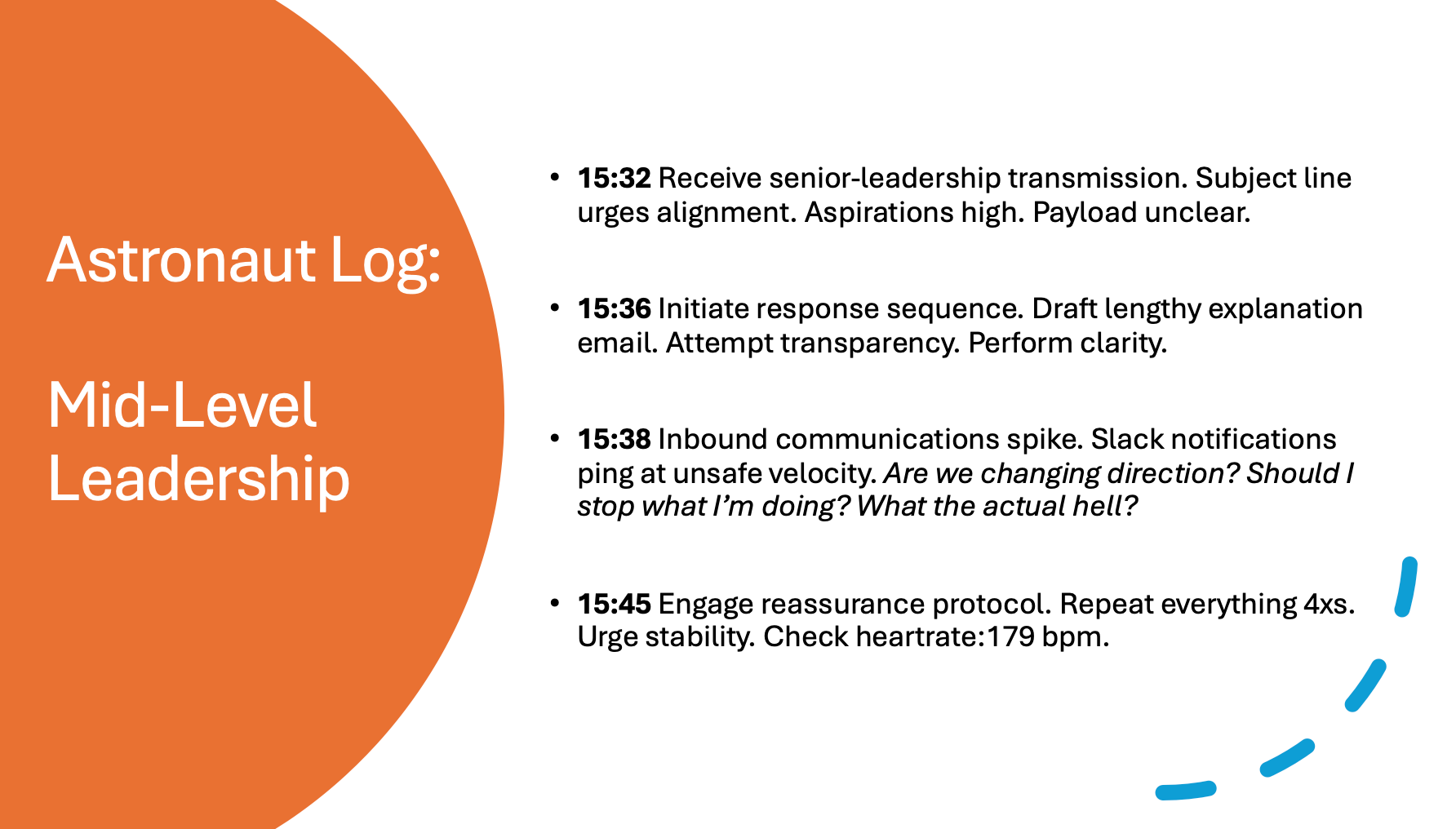
Once you’ve logged what you keep doing, you need to get real with yourself about whether all these practices are actually working. Are they functional for your team?
For example, all those clarifying messages you put out there might make you feel less anxious. But what discomfort might you be trying to avoid in yourself? What ambiguity are you trying to eliminate? What open-endedness are you averting?
Ask yourself, after I send that 859-word email, does my team have a clear grasp on what they’re supposed to do differently?
There’s a big difference between what makes you feel a little less anxious and what equips your team to align with a new policy direction from on high.
Slipping Out of the Impossible Position
Too often, mid-level leaders sound like the old man in Aesop’s donkey fable. First, the guy puts his grandson on the donkey’s back and walks beside them. But passersby said the boy’s being selfish, making the old man walk. So the old man gets on the donkey with his grandson—and people complain they’re cruel to the donkey. So the old man and the boy carry the donkey between them. People now say they’re both crazy.
You know the usual moral: stop listening to the crowd; do what you think’s best.
But for mid-level managers, the moral’s different. Think of the donkey as the message you get from higher-up. The donkey looks ready to ride. But is it?
Maybe don’t quickly forward the message to your team and let them ride it however they want. Internal comms research suggests they might get confused.
Maybe don’t hop on the message yourself, owning the damn thing as if it’s your own. Again, internal comms research suggests your own credibility will suffer.
Instead, ask a different question. Not, who should ride the donkey? But, should the donkey be ridden at all?
Practicing communicative constraint rather than communicative dutifulness makes discretion the better part of volume. Dutifulness is all about volume and transparency and, in its own way, avoidance. But constraint enables flexibility and discretion and openness for what yet may come.
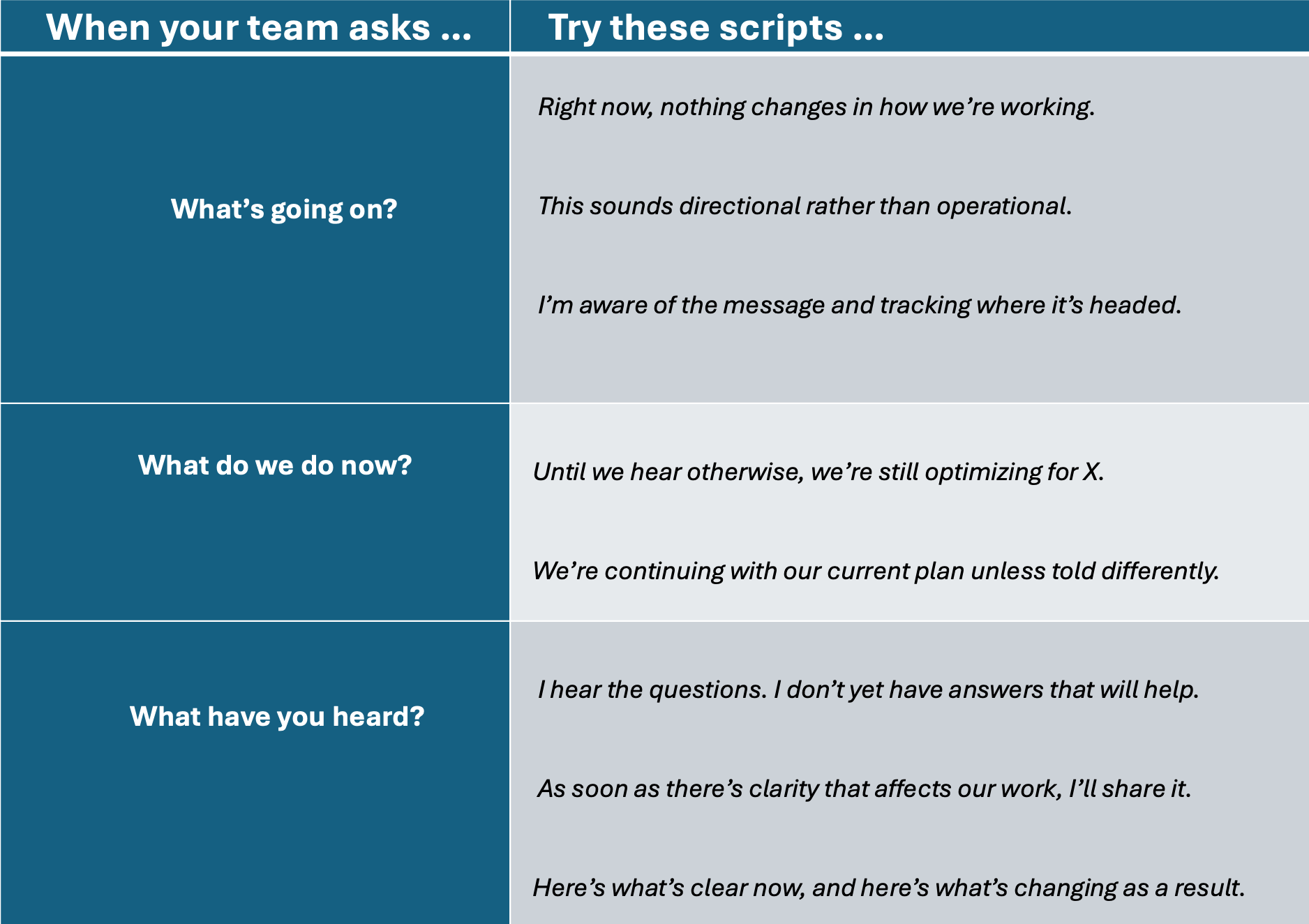
Safe journey to you! (And, hey, if you’re looking for ways to script some constraint with your team, check out the table below.)

The name has been changed here to protect the interviewee’s relation to his company.